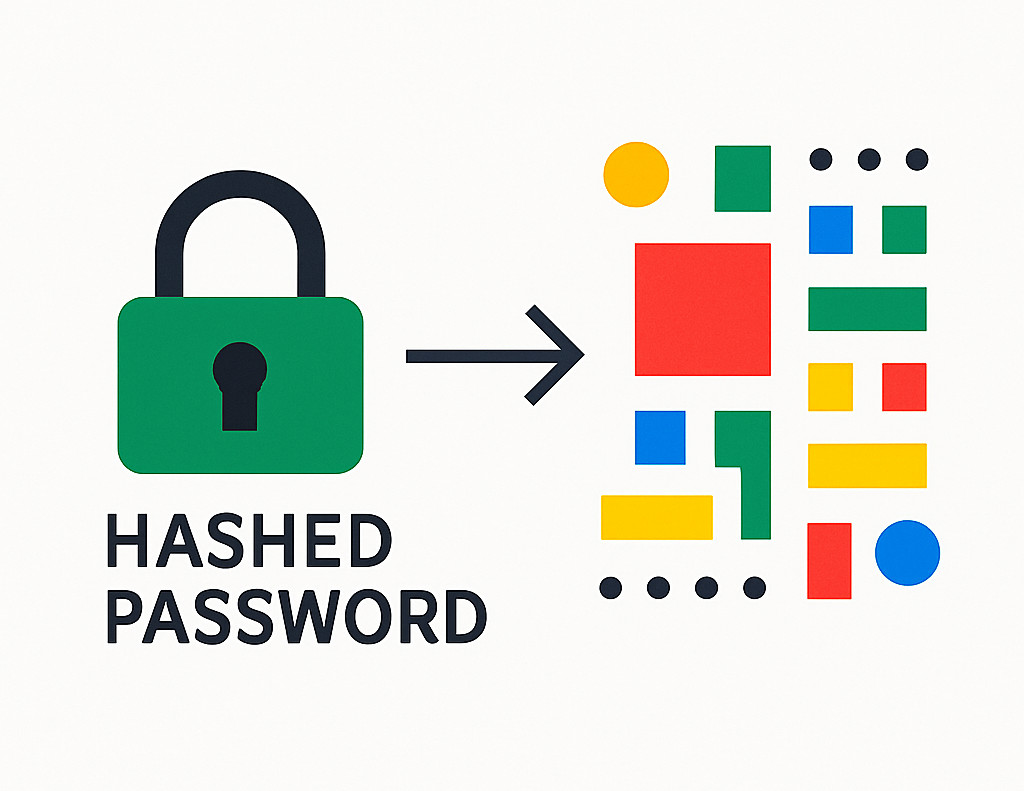
A hashed password is the result of a one-way mathematical function that takes your original password and converts it into a fixed-length string of seemingly random characters. This process, called hashing, is fundamental to digital security because it allows a system to verify your password without actually storing it. When you type your password during login, the system hashes your input and compares it to the stored hash. If they match, access is granted. The core value lies in the one-way nature of the transformation; it is computationally infeasible to reverse the hash back into the original password.
The necessity for this system arose from the catastrophic failures of storing passwords in plain text. In those early architectures, a breach of the user database meant an attacker instantly gained everyone's credentials. Hashing represented a paradigm shift. Instead of safeguarding the secret itself, systems began safeguarding a unique, irreversible representation of that secret. This meant that an attacker who stole the password file would not immediately possess usable credentials. They would be left with a collection of digital fingerprints, but not the fingers that made them.
The properties of a cryptographic hash function are what make this possible. The process is deterministic, meaning the same input will always produce the identical hash output, which is essential for verification. It exhibits an avalanche effect, where a minute change in the input, such as changing a single capital letter, produces a drastically different and unpredictable hash. Most critically, it is pre-image resistant, meaning it is designed to be a one-way street. Given a hash output, there is no practical algorithm to discover the original input. Finally, it is collision-resistant, making it highly unlikely for two different passwords to ever produce the same hash value.
The Persistent Challenge of Password Cracking
Despite these robust properties, hashed passwords are not impervious to attack. The primary vulnerability stems from the fact that hash functions are public and deterministic. While you cannot reverse the hash, you can guess the input and run it through the same function. This has led to highly efficient cracking methodologies that exploit the predictability of human-chosen passwords.
The most straightforward attack is the brute-force attack, where an attacker systematically checks all possible combinations of characters until they find a match. While theoretically sound, this is often impractical for longer passwords due to the exponential growth of possibilities. A more refined and potent technique is the dictionary attack, where an attacker hashes a list of common passwords, words from various dictionaries, and known leaked credentials, then checks these hashes against the stolen list. This is remarkably effective because a significant portion of users still relies on simple, common passwords.
The evolution of these attacks led to the development of pre-computed rainbow tables. These are massive, pre-generated databases that map hash values back to their likely plaintext inputs. An attacker with a file of unsalted hashes can simply look up each hash in the rainbow table to instantly recover the password. The effectiveness of rainbow tables against unsalted hashes was a major catalyst for the next defensive innovation.
The introduction of salting was a pivotal moment in password security. A salt is a unique, random string of data generated for each password. Before hashing, this salt is combined with the user's password. The resulting hash is stored in the database alongside its salt. Because the salt is unique for every user, even two users with the identical password will have completely different hash values. This simple addition completely invalidates the use of pre-computed rainbow tables. An attacker who steals a salted database must launch a new, separate attack for each individual password-salt combination, a process that is orders of magnitude more time-consuming and resource-intensive.
However, salting alone is insufficient against determined attackers with modern hardware. Specialized systems using GPUs and ASICs can compute billions of hash guesses per second. To counter this, the security community moved towards intentionally slow hash functions. Algorithms like bcrypt, scrypt, and the current winner of the Password Hashing Competition, Argon2, were designed with configurable work factors. These factors allow system administrators to intentionally slow down the hashing process, introducing iterative rounds or demanding large amounts of memory. For a single login attempt, a delay of a few hundred milliseconds is imperceptible to a user. For an attacker attempting billions of guesses, that same delay becomes an insurmountable economic barrier, reducing cracking rates from billions per second to mere thousands.
Common Misconceptions and User Responsibilities
A frequent point of public confusion occurs in the aftermath of a data breach. A company might announce that passwords were stored in a "hashed" format, prompting users to ask why a password change is necessary if the passwords were not exposed in plain text. The answer is nuanced and lies in the details of the implementation. The critical questions are: were the hashes salted, and which specific hash function was used? A database of passwords hashed with a fast algorithm like MD5 and without salting is highly vulnerable to rapid cracking, especially for weak passwords. The recommendation to change passwords is a precaution against the probability that attackers will successfully crack a significant portion of the hashed values over time.
Another common question revolves around whether a service can truly be ignorant of a user's password. In a properly designed system, the answer is yes. The service should only handle the plaintext password during the initial creation or at the moment of login. It is hashed immediately, and the original is discarded from memory. The widespread adoption of the "password reset" workflow, as opposed to "password recovery," is a strong indicator that a service is following this best practice. If they cannot email you your old password, it is because they do not possess it.
Ultimately, the strength of the entire hashing architecture is bottlenecked by the quality of the user's password. No cryptographic technique can protect the password "123456". Attackers' cracking dictionaries are meticulously crafted to prioritize common passwords, phrases, and known patterns from previous breaches. This is why the consistent advice from security professionals is to use long, complex, and unique passwords for every service. The use of a password manager is no longer a convenience but a necessity for generating and storing these strong, unique credentials. The mathematical robustness of the hash function is rendered moot if the input is easily guessable.
Broader Implications and Future Directions
The principles of cryptographic hashing find critical applications far beyond password storage. The concept of a unique digital fingerprint is used to ensure file integrity. When you download a large software installer, the provider often publishes its official hash value. After downloading, you can generate a hash of your local file. If the two values match, you have a cryptographic guarantee that the file is authentic and was not altered or corrupted during transfer.
This same principle is the foundational mechanism of blockchain and distributed ledger technologies. Each block in a chain contains the hash of the previous block's header. This creates an immutable and tamper-evident record. Any attempt to alter a transaction within a historical block would change its hash, which would invalidate the hash in all subsequent blocks, breaking the chain's continuity and signaling the alteration to the entire network. Here, the deterministic and avalanche properties of hash functions are what engender trust in a decentralized system.
The future of authentication is gradually moving beyond the password. The widespread adoption of phishing-resistant Multi-Factor Authentication (MFA) adds a critical, independent layer of security, ensuring that a compromised password is not sufficient for access. More profoundly, the development of passwordless authentication standards, such as FIDO2 and WebAuthn, is gaining significant traction. These protocols allow users to authenticate using physical security keys or platform-integrated biometrics like fingerprints or facial recognition. They are based on public-key cryptography, where a private key, never leaving the user's device, is used to sign challenges from the online service. This method is inherently resistant to phishing and eliminates the risks associated with password databases entirely.
The landscape of password security is a continuous cycle of innovation and countermeasure. The defensive strategy of salting was met with more powerful, targeted brute-force attacks, which were in turn countered by the development of deliberately slow hashing algorithms. This ongoing contest highlights that security is a process, not a static destination. For now, the hashed password, when implemented with a unique salt and a modern, slow function like Argon2, remains a vital component of our digital infrastructure. Its continued effectiveness, however, is a shared responsibility between the engineers who deploy it correctly and the users who create strong, unique secrets to feed into it.
Overview
A hashed password is a transformed, irreversible version of a password created through a one-way cryptographic function so that even the system storing it cannot recover the original text; when paired with unique salts, slow or memory-hard algorithms like Argon2id, and carefully chosen parameters, hashing protects users against offline cracking attempts, GPU-scale brute forcing, and large breach fallout, while avoiding the dangers of reversible encryption schemes and reducing the damage caused by weak or reused passwords.